
Dhankhar said every word spoken by a constitutional functionary is guided by the supreme sublime interest of the nation.
Trinamool Congress leader and Member of Parliament Mahua Moitra has moved the Supreme Court challenging an order of the Election Commission of India for special intensive revision of electoral rolls in Bihar.

No headway in meeting between AIFF and FSDL

The Supreme Court has directed authorities to relocate stray dogs from institutional areas like schools and hospitals to designated shelters due to a rise in dog bite cases. The court also addressed the issue of stray animals on highways.

With the livelihood of nearly 5,000 people at stake, and FIFA, the Asian Football Confederation and global players' union FIFPRO keeping a close watch, the Court fixed August 28 as the next date of hearing.

The Supreme Court acknowledged a clean chit from a special investigation team (SIT) regarding the Vantara zoological rescue and rehabilitation centre in Gujarat's Jamnagar, following allegations of irregularities.
Tamil Nadu's unending legislative fight for exemption from NEET has now flagged the question if it's time to review the Supreme Court's famous verdict in the 'Mandal case', fixing 50-per cent upper-limit for all reservations, asks N Sathiya Moorthy.

During the presser, Gandhi showed a picture of a woman who appears on the voter list 22 times in 10 booths in the Rai assembly constituency, and said this shows that this was a 'centralised operation'.
Officials aware of the procedure to appoint and remove Supreme Court and high court judges pointed out that while defending his case before lawmakers in any of the House, Justice Varma can announce that he is quitting and his verbal statement will be considered as his resignation.

Actor-politician Vijay, founder of Tamilaga Vettri Kazhagam, is set to resume his political campaign on Sunday in Kanchipuram district. He will address people at an indoor facility, with arrangements made for a smooth event. Approximately 1,500 people with QR-coded passes will be allowed entry, and security measures are in place.

The Election Commission will conduct phase two of the special intensive revision of electoral rolls in 12 states and Union territories between November and February, Chief Election Commissioner Gyanesh Kumar announced on Monday.

The Supreme Court has sought responses from the Centre and Union Territory of Ladakh regarding the detention of climate activist Sonam Wangchuk under the National Security Act. Wangchuk's wife filed a plea seeking his release. The court has scheduled the next hearing for October 14.

Reliance Foundation's Vantara has pledged full cooperation with the Supreme Court-appointed SIT investigating allegations of legal non-compliance and animal acquisition irregularities.
Gitanjali Angmo, wife of climate activist Sonam Wangchuk, has filed a plea in the Supreme Court seeking his release from detention under the National Security Act. Wangchuk was detained following protests in Ladakh. The plea challenges his detention and alleges violations of due process.
'The definitions in the Act are so wide and so vague that they can be easily misused to target individuals who may not be conducive to the present government in power.'

The Supreme Court of India has ruled that religious conversions undertaken solely to avail reservation benefits without genuine belief in the adopted religion amount to "fraud on the Constitution". The court upheld a Madras High Court decision denying a scheduled caste certificate to a woman who converted to Christianity but later claimed to be a Hindu to secure employment benefits.

The cases, brought to light by Team Aid, a non-governmental organisation specialising in repatriation assistance, have sparked calls for urgent government intervention to resolve what campaigners describe as a "humanitarian crisis".
'Instead of the government and telecom operators solving the mess of their own creation, they're telling us we need to give access to our phones perpetually.'

The Supreme Court is scheduled to hear a plea on August 8 seeking directions to the Centre for the restoration of statehood to Jammu and Kashmir. The plea highlights concerns about the delay and its impact on democratic rights and development.
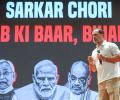
'Rahul Gandhi's problem is that he doesn't think big.' 'He looks more like an activist, while politics is like a game of chess. You attack and then defend and have a game-plan.'
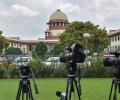
A petition filed by Swapnil Tripathi, a final year student studying at the National Law University, Jodhpur, prompted the Supreme Court to allow live streaming of the opaque proceedings within.
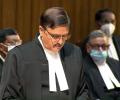
Justice Abhay S Oka, known for his unwavering commitment to liberty and constitutional values, bid farewell to the Supreme Court of India. In his final address, he stressed his dedication to upholding constitutional liberties, emphasizing that it was his "honest endeavor" to fulfill the dream of the Constitution's framers. He also expressed gratitude to the bar and his colleagues for their support and shared heartfelt memories from his time on the bench. Justice Oka's departure marks the end of a distinguished judicial career spanning over two decades, during which he served as a judge of the Bombay High Court, Chief Justice of the Karnataka High Court, and ultimately, as a Supreme Court justice.
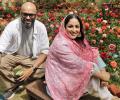
'I wanted to go for the heart, and at the same time, open the audience's mind.'

The Rajasthan Legislative Assembly has terminated the membership of BJP MLA Kanwar Lal Meena after he was convicted and sentenced to three years in jail for pointing a pistol at a sub-divisional magistrate. Meena's membership was terminated effective from May 1, following legal opinion from the advocate general and senior legal experts. Meena had approached the Supreme Court seeking suspension of his sentence, but the top court dismissed his plea and directed him to surrender within two weeks. The Election Commission has been informed of the vacancy, and a by-election on the Anta seat would be held within six months.
The Supreme Court dismissed Allahabad High Court judge Yashwant Varma's plea seeking invalidation of a report that found him guilty of misconduct in the cash discovery row.

'You can't make art with a point of view of fear. You have to present the truth.' 'That's why such films are not being made these days.' 'You never put the truth in the script because you fear you might offend somebody.'

The home ministry said the central government would continue to welcome the discussion with LAB and KDA through the high powered committee on Ladakh or any such platform.
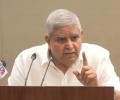
Rajya Sabha member Kapil Sibal has criticised Vice President Jagdeep Dhankhar for questioning the judiciary over the timeline for the president to take decisions, calling it "unconstitutional " and a lowering of the dignity of the chair. Sibal asserted that Dhankhar's remarks are not neutral and amount to an attack on the judiciary by the executive. He also pointed out that the president acts on the aid and advice of the council of ministers, and therefore, the president's power cannot be curtailed. Sibal urged Dhankhar to seek a review of the judiciary's decision or an advisory opinion from the Supreme Court if he has problems with it. He also questioned why Dhankhar only focuses on actions taken during Congress governments and not after 2014.

The Congress party has accused the Election Commission of India (ECI) of incompetence and partisanship following the Chief Election Commissioner's (CEC) defense of the Special Intensive Revision (SIR) of electoral rolls in Bihar. The party alleges the CEC failed to address concerns about voter list irregularities and is acting in favor of the ruling BJP.

The season-opening Super Cup will kick off from October 25 in Goa, an official of the All India Football Federation (AIFF) said on Tuesday.
The Supreme Court questioned Justice Yashwant Varma regarding his plea to invalidate an in-house inquiry panel report that indicted him after a large amount of burnt cash was discovered at his official residence during his time as a Delhi High Court judge.
The CBI will seek police remand of eight Jammu and Kashmir Police personnel arrested for allegedly inflicting brutal custodial torture on a fellow constable in 2023. The case involves allegations of severe abuse and mutilation, leading to a Supreme Court-ordered investigation.
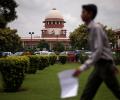
The Supreme Court has initiated a suo motu case regarding investigation agencies summoning lawyers and will examine if they can be put to notice. The action follows the Enforcement Directorate summoning senior lawyers, which was condemned by bar associations.

Made at a time when an insidious agenda can be read into it, Haq is an important film that deals with a contentious subject with maturity, observes Deepa Gahlot.

'Some films are meant to more than just entertain you. They are meant to challenge, provoke, push you to think, instil change, and be in the public conversation.' 'That is Haq.'
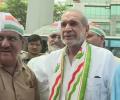
A Delhi court sentenced former Congress MP Sajjan Kumar to life imprisonment for his role in the murder of two Sikhs during the 1984 anti-Sikh riots. The court cited Kumar's age and illness as mitigating factors in its decision to impose a lesser sentence than the death penalty. Kumar was convicted for being part of a mob that set fire to the victims' home and killed them. This is the second life imprisonment sentence for Kumar in connection with the 1984 riots. He is also facing other charges related to the riots.
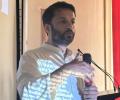
Acting on the Supreme Court's direction, Haryana's Director General of Police Shatrujeet Kapur has constituted a Special Investigation Team (SIT) to investigate two FIRs against Ashoka University associate professor Ali Khan Mahmudabad. The SIT, headed by Additional Director General of Police (Crime) Mamta Singh, will include Superintendent of Police (Karnal) Ganga Ram Punia and Superintendent of Police (STF, Gurugram) Vikrant Bhushan. The SIT will expeditiously complete the investigation and submit a report at the earliest. Mahmudabad was arrested on May 18 for his social media posts on Operation Sindoor, which were alleged to have endangered the sovereignty and integrity of the country. The Supreme Court granted him interim bail on Thursday, but refused to stay the investigation.
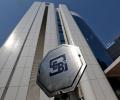
The Securities and Exchange Board of India (Sebi) has identified around Rs 77,800 crore as "difficult-to-recover" or DTR dues in its annual report for 2024-25 (FY26), marking a nearly 2 per cent increase from the previous year. These dues remain unrecovered despite exhaustive recovery efforts.
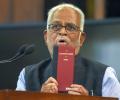
'Earlier, we used to talk about a deficit economy. There is a deficit in democracy' 'If you read superficially Gandhi and Ambedkar and Nehru, some misconceptions and misunderstanding come to mind, as if they were at loggerheads and they differed radically in their views' 'India is one nation. There is only one citizenship. No citizenship for South India and no citizenship for North India and another for the Northeast'

The move comes barely two days after the authorities lifted the restrictions in Leh, 22 days after they were first imposed following violent clashes during protests demanding statehood and Sixth Schedule Status that left four persons dead and 90 injured on September 24.
